Ovisy · EMD study 2026
Do exact match domains still work? I spent $224 to find out
Download the full study (PDF) →If you want the really short answer, buying an exact match domain today won’t rank you by itself. Won’t help you with AI assistants either (with a small exception).
Loads of SEOs (me included) swear by EMDs and buy a new bestandsexiestseoever.com whenever we can (or the .si version, because that’s hip with the kids rn).
But I wanted to see if it really has any relation to reality or if it’s just something we picked up and think works because it used to work way back when.
So I checked.
What I looked at
- 7,374 commercial keywords in the US and UK, across 10 industries (from plumbers and lawyers to VPNs, CRMs and calculators)
- 106,130 organic results from the top 20, plus AI Overviews and map packs
- A second, local sample of 6,267 keywords in 40 cities, from Houston to Swansea, where EMDs are very popular
- 3,048 new domains registered in 2024 and 2025, tracked to see what happened to them
- About 60,000 answers from GPT-4.1 mini, Gemini Flash and Claude Haiku
Domains were checked in Ahrefs, SERPs came from DataForSEO, and everything was compared on the same SERP, so a plumber in Tulsa is compared with other plumbers in Tulsa, not with Wikipedia.
1. Where EMDs still show up
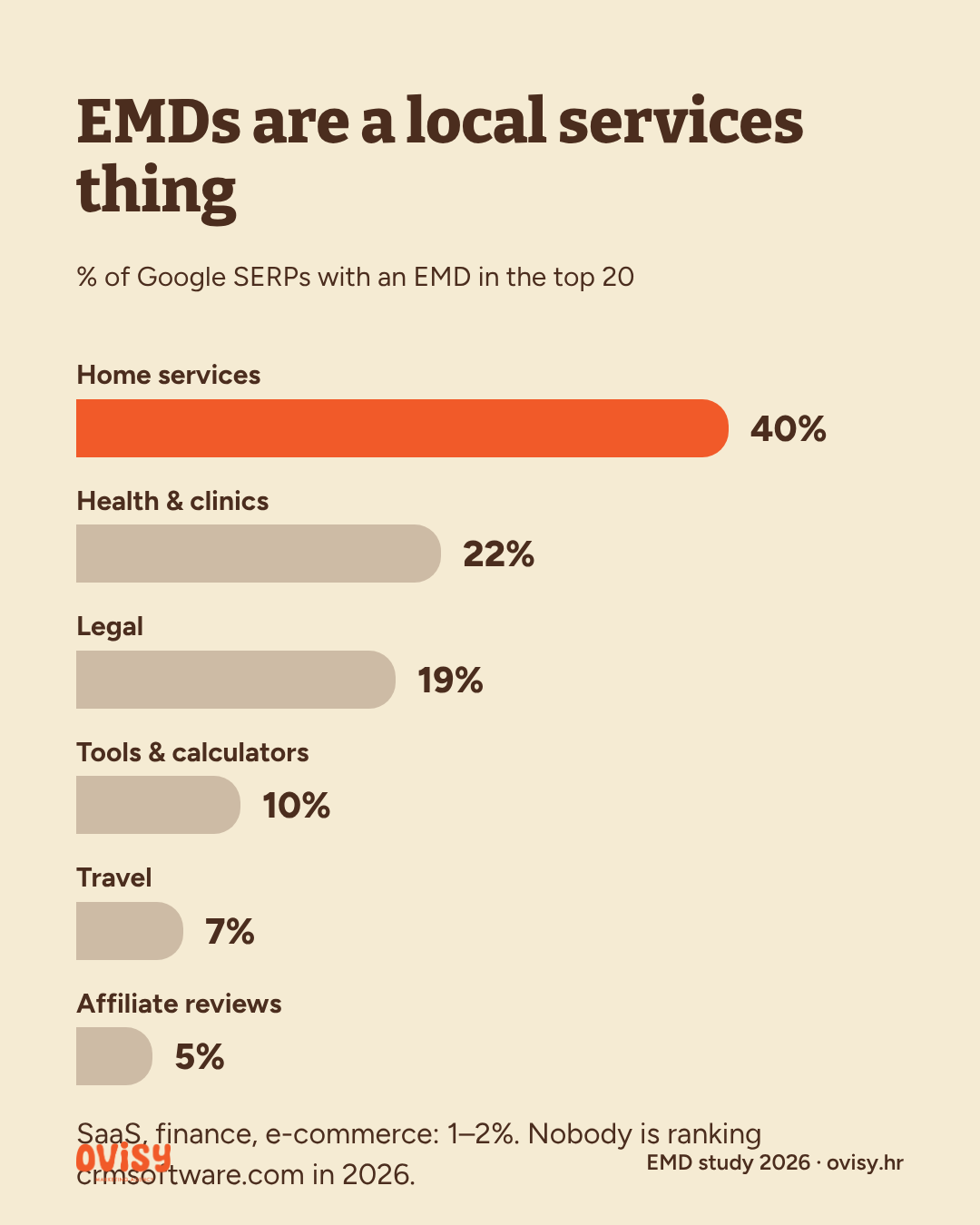
EMDs are mostly a local services thing.
- Home services: 40% of SERPs have at least one EMD in the top 20
- Health and clinics: 22%
- Legal: 19%
- Tools and calculators: 10%
- SaaS, finance, e-commerce: 1-2%
Overall, 11.9% of US and 8.9% of UK SERPs have one. Wouldn’t say anyone will be able to rank for crmsoftware.com in 2026, sadly.
2. Do they rank better in Google?
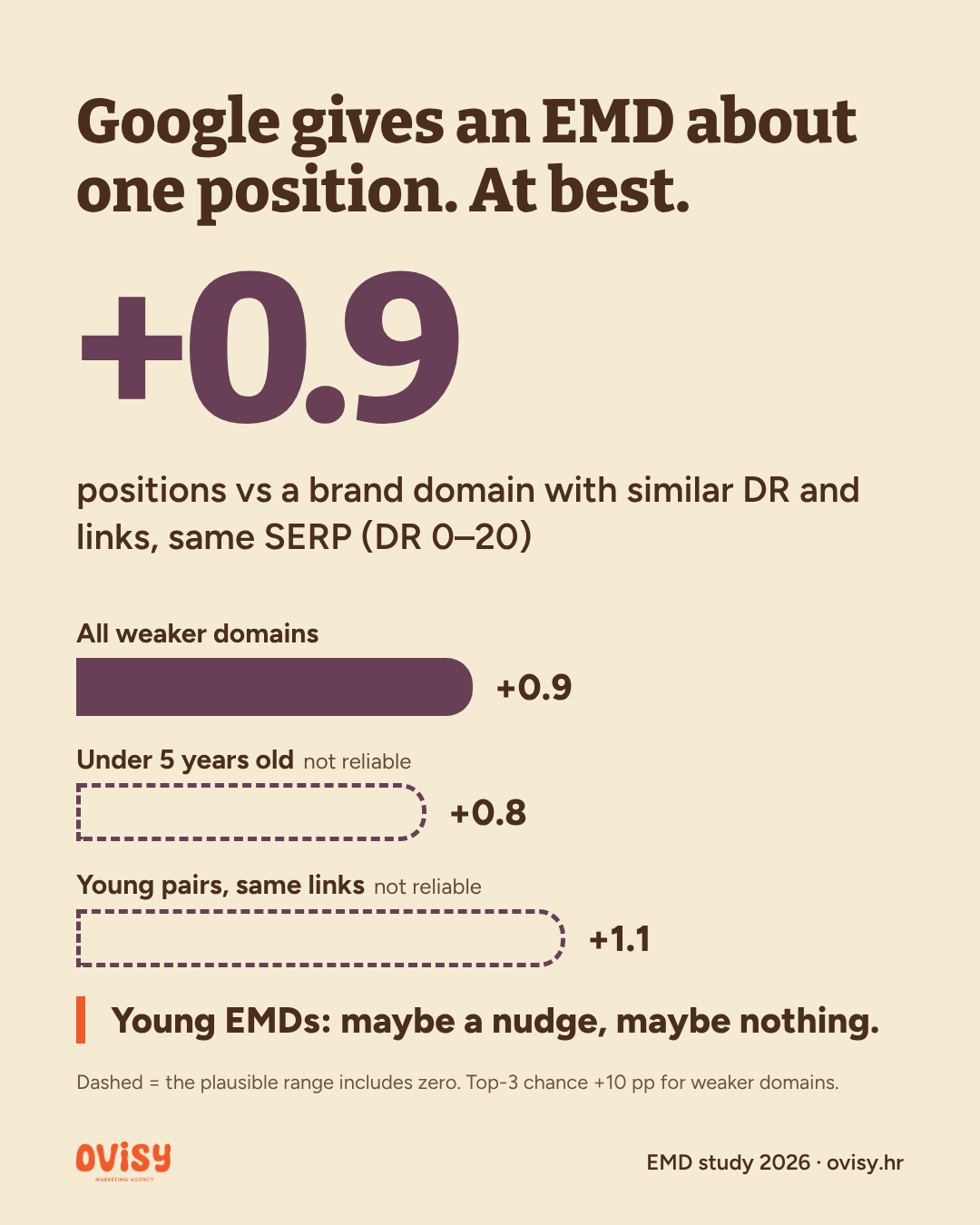
A tiny bit, but not the ones you can easily buy today.
When you compare an EMD with a brand domain of similar strength (DR 0-20, similar links, same SERP), the EMD ranks about 0.9 positions higher and has a 10 percentage points better chance of being in the top 3.
Sounds nice, right? HOWEVER.
For domains younger than 5 years, the estimate is similar (0.8 positions), but the uncertainty is so big that it could also be zero. When I paired young EMDs with young brand domains with almost identical links, the result was the same story.
And this is the best case for EMDs, because I’m only measuring sites that already rank in the top 20, and EMDs are usually bought by SEOs, so those sites are probably better optimised in general. I checked keyword in the title and it changes nothing, but overall on-page quality I can’t measure. So part of that 0.9 is probably not the domain at all.
Also, 78% of ranking EMDs have fewer referring domains than the typical competitor on the same SERP. So yes, some EMDs do have a slight boost, just not by much.
3. What happens when you buy one today?
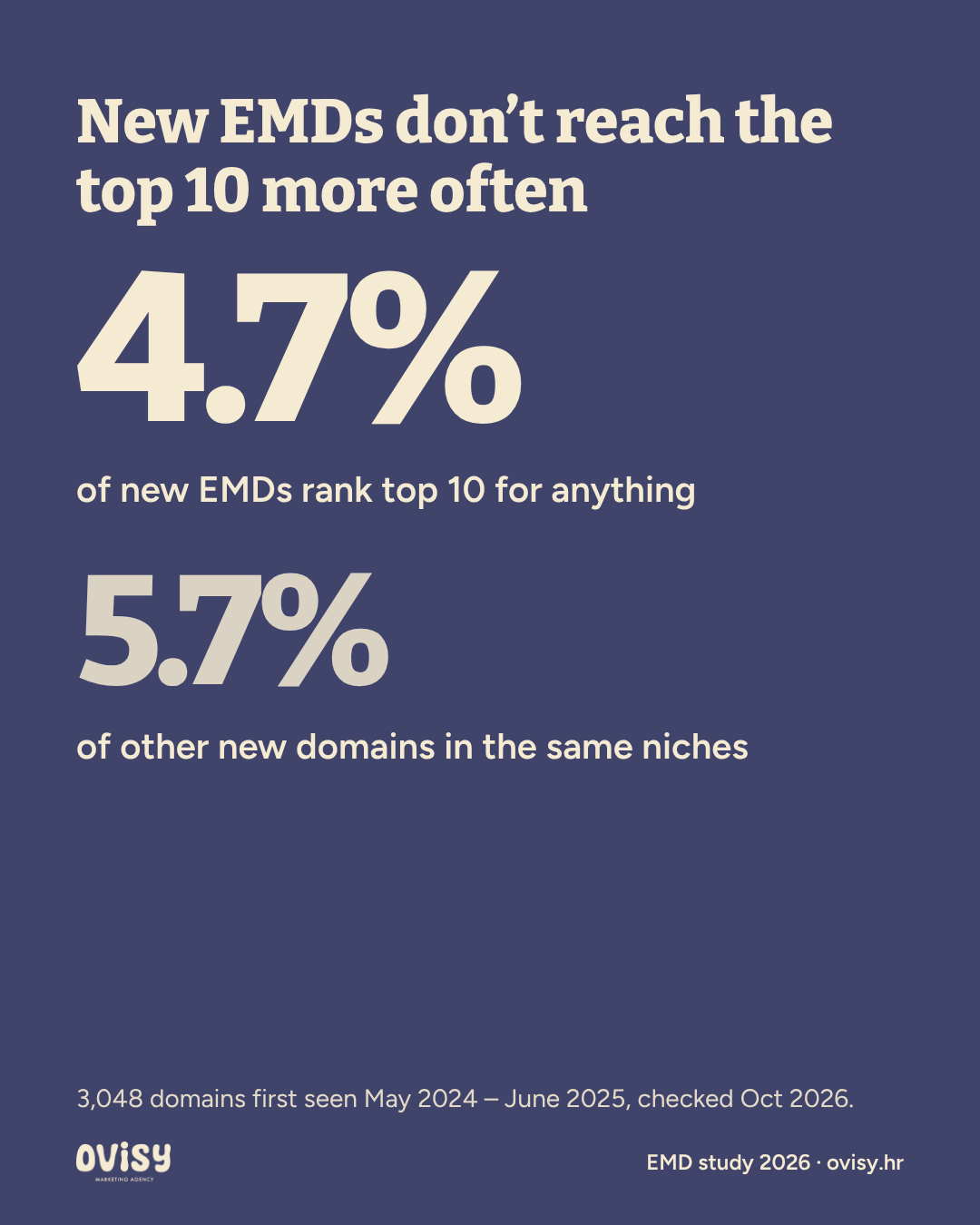
I took every new domain I could find in Certificate Transparency logs for 36 niche terms (plumbing, roofing, dentists, towing, solar, vets, wedding venues, VPNs…), registered between May 2024 and June 2025. That’s 3,048 domains of which 1,333 are still alive.
Then I checked how many rank in the top 10 for anything, 16-29 months later:
- New EMDs: 4.7%
- Other new domains from the same niches: 5.7%
No difference. If anything, the EMDs are a bit behind.
For their own keyword, only 2.5% of new EMDs are in the top 10. And most of those “wins” are names like mywaterdamagehero.com, ranking for “my water damage hero” with 40 searches a month. Basically ranking for their own brand name. For real commercial keywords (100+ searches a month), it’s 0.7%.
The bigger finding is that about 94% of new domains don’t rank for anything at all, EMD or not. The bottleneck is building an actual website, not the name. Shocking, I know.
Anecdotally though, I’ve seen new EMDs jump to the first page for their exact keyword almost instantly, and then slide down a few weeks later.
My guess is that Google immediately gets what the site is about, but that boost disappears fast if the site isn’t good. I measured these domains once, more than a year after launch, so the data can’t confirm or kill that. That could be the next thing to test.
4. Do LLMs prefer EMDs?
Here it gets fun.
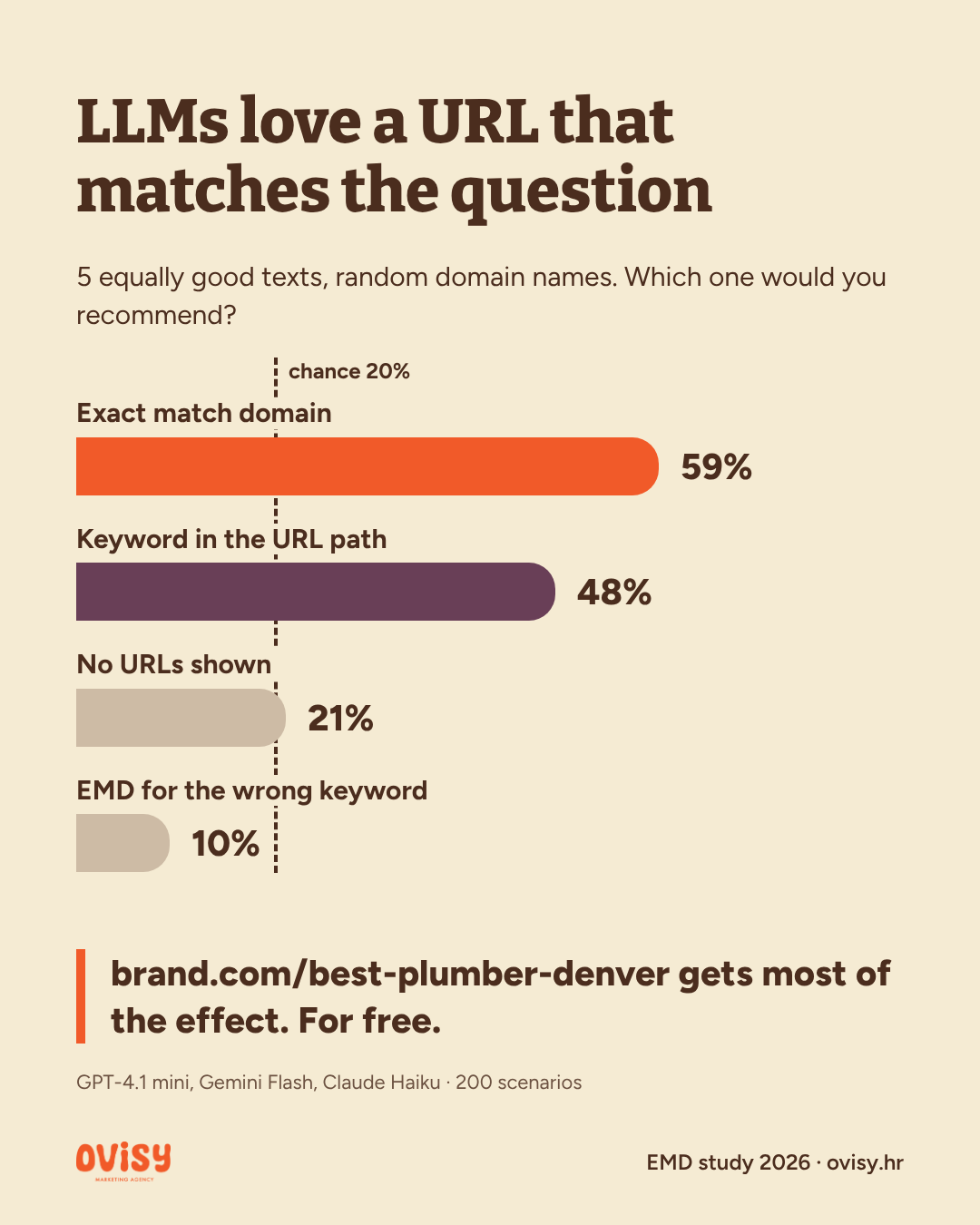
I gave the models five equally good texts and randomly assigned domain names to them. One got the exact match domain, one a partial match and three got brand names. If the domain didn’t matter, each would get picked 20% of the time.
The EMD got picked 59% of the time.
So I ran three more versions to see why:
- No URLs shown at all: the same text wins 21%, so the texts really are equal
- Keyword only in the URL path (brand.com/best-plumber-denver): 48%
- An EMD for a different keyword in the same industry: 10%
So the models aren’t in love with EMDs. They like a URL that matches the question. And a keyword in the path gets you most of that boost for free.
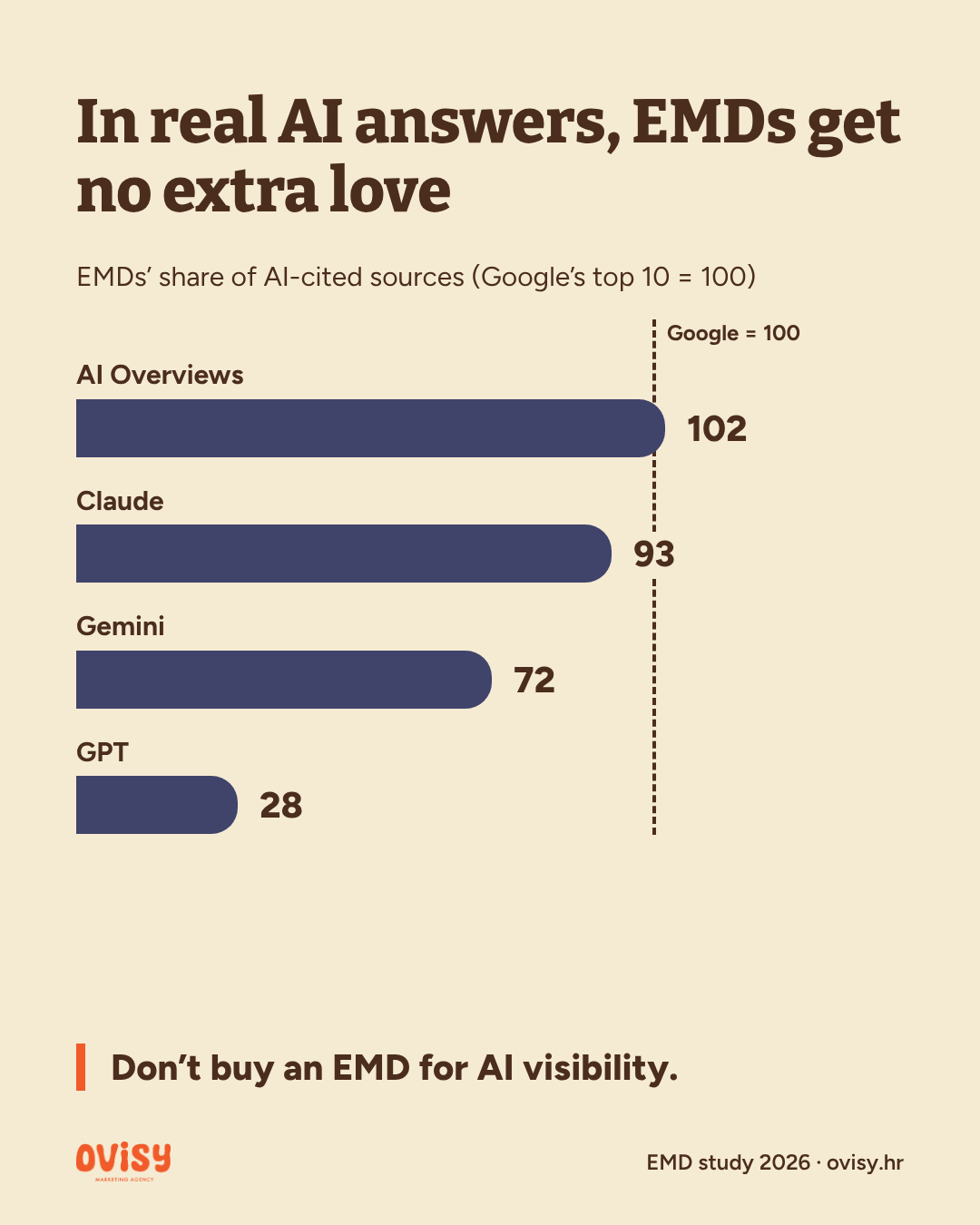
5. But do they cite EMDs more in real answers?
Nope.
When the assistants actually search the web, I compared the share of EMDs among the sources they cite with the share of EMDs in Google’s top 10 for the same queries. If Google is 100: AI Overviews 102, Claude 93, Gemini 72, GPT 28. So AI Overviews cite EMDs exactly as often as they rank, and GPT clearly avoids them.
The controlled test only matters once your page is already retrieved. And getting retrieved still mostly depends on ranking.
What about the .si wave?
After September 2026, a lot of people started buying .si domains. I built the .si version of about 1,100 commercial keywords from the study (bestvpn.si and friends) and checked the certificate logs.
Only 18 have ever had an HTTPS site, and 4 appeared after the wave. So far the .si rush has barely touched commercial keyword domains. Also, Google treats .si as Slovenian, not generic. I’ll recheck in 3 and 6 months.
So, should you buy an EMD?
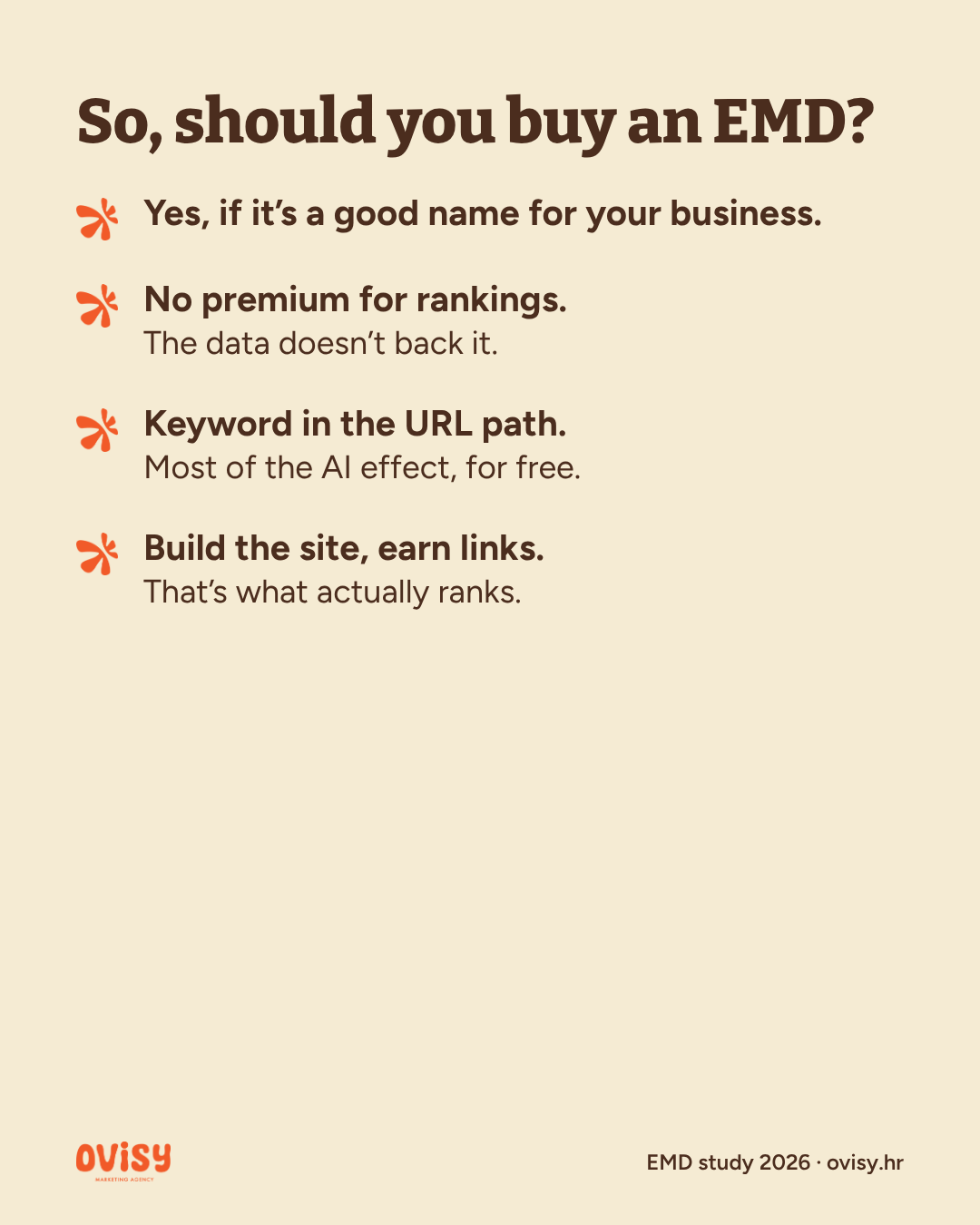
- Buy it if it’s a good, memorable name for a local business. Joe’s Denver Plumbing is a real brand too.
- Don’t pay a premium expecting rankings. The data doesn’t back it.
- If you want the AI “relevance” boost, put the keyword in the URL path. Costs nothing.
P.S. The whole thing cost $224 in API credits. Cheaper than most EMDs on the aftermarket. 😎